The 47-Second Mind: Why I’m Refusing to Let the Algorithm Anchor My Coaching
Before I dive into this, I want to clear the air: I have immense respect for full-time influencers and social media masters. Building an audience of hundreds of thousands, let alone a million followers, is not a stroke of luck. It requires staggering hard work, relentless consistency, and a massive creative commitment. It is a legitimate craft, and I applaud those who master it. But as I look at the landscape of my own work, I’ve had to face a hard truth: that path is simply not for me.
I caught myself doing it again last night.
I was staring at the dashboard for WIM4life’s social media pages, looking at metrics like "reach," "engagement rate," and "impressions." Every marketing guru out there tells me the same thing: If you want your coaching business to survive, you have to feed the beast. You need 15-second Reels, daily TikToks, and flashy hooks to capture the modern mind.
Yet, looking at those numbers, I felt a deep, heavy reluctance. Less than three pages into trying to script a "trending" video, I closed the laptop.
I am, I suppose, decidedly old-school. I still fiercely believe in the power of word-of-mouth. I still hope—perhaps stubbornly—that the people who truly need the life-altering change coaching provides, will find me not through a viral 7-second audio trend, but because someone they trust said, "This changed my life. You need to talk to her."
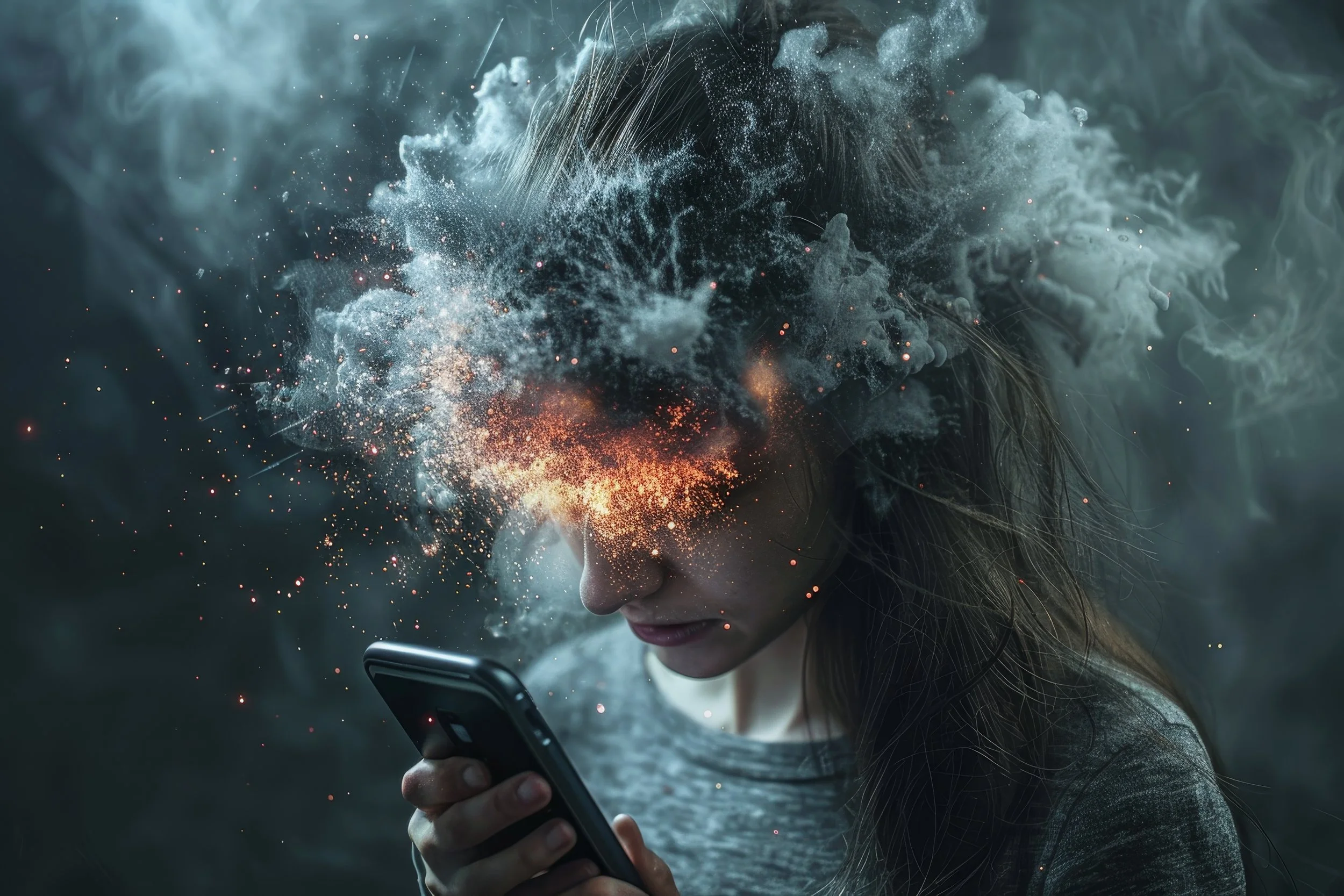
But as a coach, I am watching what this digital landscape is doing to the very people I want to help. Humanity is currently caught in the grip of a massive, silent addiction. We are living through a collective crisis of attention, and it is reshaping our brains, our reading habits, and our ability to connect with deep, meaningful transformation.
The Hard Data: Our Shrinking Window of Focus
We can't talk about meaningful life changes without looking at the reality of the modern mind. The data paints an alarming picture of why the "scroll" is destroying our depth.
According to Dr. Gloria Mark, a prominent attention researcher at UC Irvine, the average time a person spends focusing on a single digital screen before switching tasks has plummeted. In 2004, it was two and a half minutes. Today, it has dropped to a mere 47 seconds.
When we dive into short-form video platforms like TikTok or Instagram Reels, the window shrinks even further:
Gen Z Post Attention: 6.5 seconds before scrolling to the next post.
The "Hook” Window: Creators have just 1.5 to 3 seconds to grab your attention before you swipe.
The Recovery Cost: It takes an average of 23 minutes and 15 seconds to fully refocus on a complex task after just one digital interruption.
Think about that last statistic. Every time someone pauses their day to check a quick text or scroll for "just a minute," they place a massive cognitive tax on their brain. How can we expect people to do the deep, introspective work required in coaching when their attention spans are chopped up into 47-second increments?
Why Cheap Dopamine Kills Real Transformation
This isn't just a failure of willpower; it is a chemical hijacking.
Every time someone scrolls through their feed, the algorithm serves up a "variable reward"—the psychological mechanism behind slot machines. One video is boring, the next is shocking, the next is hilarious. This unpredictability triggers a massive spike in dopamine.
We often think of dopamine as the "pleasure" hormone, but it’s actually the hormone of anticipation, craving, and pursuit. It doesn't say, "This feels good." It says, "Look at that! What's next? Do it again!"
When a brain is flooded with effortless, high-velocity digital dopamine, it alters its baseline sensitivity. Meaningful, real-world "feel-good" experiences—like doing the hard work of mindset shifting, having an honest conversation with a coach, or building a new life habit—require time, effort, and discomfort.
When your receptors are fried by digital dopamine, real life and real growth feel incredibly boring by comparison. People are trading long-term serotonin (the hormone of actual fulfillment, peace, and satisfaction) for short-term dopamine cravings. They are full of stimulation, but entirely empty of joy.
Reclaiming the Space: WIM4life’s Digital Philosophy
This is exactly why I am manifesting the rules of engagement for WIM4life.
Yes, we have an Instagram page. Yes, we have a Facebook page. It is the “must do not negotiable trend”, and it’s where people look to see if you exist. But I refuse to play the numbers game. I refuse to reduce the profound art of personal growth into a 5-second aesthetic reel just to beat an algorithm.
Our intention for WIM4life’s social media is not to become a megaphone for viral content, but to build a hub of minds alike connections.
I want our digital spaces to be a sanctuary, not a distraction. A place where people who actually want to resonate with each other, or with my coaching style can find a moment of pause, depth, and genuine human connection. I don’t want to catch your eye for 3 seconds while you mindlessly scroll on the toilet; I want to connect with your soul when you are ready to make a lasting change.
Now, let me be entirely fair. I don’t want to paint social media as a purely evil monster. To do so would ignore the incredible, beautiful nuance of the internet.
The truth is, I deeply appreciate a lot of the information that comes out of these channels. Social media has democratized knowledge. I have discovered groundbreaking psychological insights, life-changing wellness perspectives, and brilliant global creators whom I never would have crossed paths with otherwise. It allows us to share wisdom across oceans in a matter of seconds.
The technology itself isn't the enemy; it’s our lack of a boundary with it.
In the end, the goal is for you to find balance. It’s about learning to use these platforms as a tool for intentional learning and connection, rather than allowing them to use you as a source of raw data.
We can log on, find inspiration, gather insightful tools, and then—crucially—know when to put the phone face down. True transformation cannot be hyper-skimmed, and it certainly won't happen in 47 seconds. Use the digital world to find the spark but step back into the real world to build the fire.
If you are tired of the fast dopamine intake, and ready for real, resonant fulfillment, the door is open. Let’s find that balance and do the real work together—undivided attention required.
Wellness to your health,
Virginia
Resources:
UCAS Media Analysis: Behavioral data outlining the strict 8-second attention threshold and fast filtering habits of younger audiences online.
ResearchGate Study: Academic research showing that digital video engagement drastically drops if a creator fails to establish a cognitive "hook" within the first 1.5 to 3 seconds.
Swiss German University Study: An analysis of how consuming dozens of short videos in one sitting causes severe context-switching, training the brain to resist long-term focus.
Harvard University Profile: A neurobiology breakdown of how social media algorithms exploit B.F. Skinner's "Variable Ratio Schedule of Reinforcement" to manipulate dopamine pathways.